
The True Cost of Darkness: 2026 Workplace Lighting & Injury Statistics
A comprehensive analysis of how inadequate illumination impacts the construction and trades industry, from multi-billion dollar economic losses to the $42,000 cost of a single slip.
The Macro Economic Impact of Workplace Injuries
In 2026, the data is clear: darkness is not just a nuisance; it is a significant financial liability. Poor visibility on jobsites and inside work vehicles remains a leading contributor to preventable accidents.
Visualizing the 2026 Risk Landscape
The $42,000 Slip: Why "Good Enough" Lighting Isn't
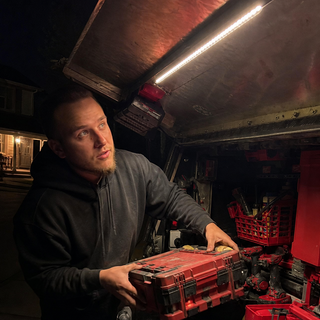
For a contractor working at 5:00 AM, the difference between a successful start and a devastating injury is often just a few hundred lumens. When searching for a specific tool in a dark truck cap or trailer, workers are 40% more likely to suffer from "minor" injuries that escalate into major costs.
A single slip or trip caused by poor visibility doesn't just hurt the worker; it cripples the business. Beyond the immediate medical bill, the indirect costs can be 4x higher than the direct costs.
- Direct Costs: Ambulance fees, ER visits, and physical therapy.
- Indirect Costs: Higher worker's comp premiums, administrative time, and project delays.
- Opportunity Costs: Lost contracts due to a lowered safety rating (EMR).
The Hidden Fuel Drain
Statistics show that contractors without dedicated battery-powered lighting often leave their trucks idling to use headlights or interior dome lights. In 2026, with rising fuel costs, this "workaround" can cost a fleet thousands in wasted fuel and unnecessary engine wear every year.
The Regulatory Price of Darkness
OSHA (Occupational Safety and Health Administration) standards for construction (29 CFR 1926.56) are strict regarding minimum illumination requirements. Failure to provide adequate light is one of the easiest violations for an inspector to cite.
| Violation Type | 2026 Penalty Amount | Impact on Business |
|---|---|---|
| Serious Violation | $16,131 per violation | Mandatory fines and immediate remediation costs. |
| Willful or Repeat | $161,323 per violation | Potential business suspension and severe reputation damage. |
| Failure to Abate | $16,131 per day | Daily compounding fines until lighting is corrected. |
Poor lighting in a truck bed or toolbox isn't just a safety hazard; it's a "serious violation" waiting to happen. Modern solutions like the Lumo-300 allow contractors to bring OSHA-compliant 900-lumen brightness to any corner of their rig without complex wiring.
Turning the Lights On: The Productivity Payoff
Research indicates that proper illumination does more than just prevent injuries—it acts as a force multiplier for worker efficiency. When tradespeople can see every socket, fitting, and tool in their kit, the "fumble factor" is eliminated.
By integrating lighting into your existing power tool battery ecosystem—whether you use Milwaukee, DeWalt, or Makita—you eliminate the need for hardwiring. This "no-drill" approach maintains the resale value of your vehicle while providing the rugged, high-lumen floodlight needed for a safe jobsite.
Methodology & Data Analysis
The statistics presented in this report are aggregated from the 2026 National Safety Council (NSC) reports, OSHA enforcement data, and independent studies on workplace ergonomics. The $181.4 billion figure represents the total cost of work injuries, including wage loss, medical expenses, and administrative costs. The productivity increase of 25% is based on time-motion studies of contractors performing tasks in 5-lux (poorly lit) vs. 300-lux (well-lit) environments.
For more technical details on how lumens affect jobsite performance, see our guide on how many lumens you really need.
Frequently Asked Questions
How does lighting specifically reduce worker's compensation claims?
Poor lighting is a primary environmental factor in slips, trips, and falls—the leading cause of worker's comp claims. By increasing visibility in high-risk areas like truck beds and trailers, employers can reduce the frequency of these accidents by up to 15%, leading to lower EMR ratings and reduced premiums over time.
What are the indirect costs of a workplace injury?
Indirect costs include the time spent investigating the accident, training a replacement worker, the loss of morale among the crew, and the legal fees associated with OSHA appeals. These are often estimated at 4 to 10 times the cost of the direct medical bill.
Why use battery-powered lighting instead of hardwiring?
Hardwiring a lighting system into a truck's electrical system can void warranties, drain the vehicle's starter battery, and requires professional installation. Cordless solutions like LumoLux use the batteries you already have on-site (Milwaukee, DeWalt, or Makita), providing a "no-wire" installation that is both safer and more flexible. Learn more about battery compatibility here.
Does OSHA require specific lighting for truck toolboxes?
While OSHA doesn't specifically name "toolboxes," it mandates minimum illumination for any "work area" and "aisle-way." If a contractor is searching for tools or performing tasks in a dark truck bed, that area is considered a workspace and must meet the foot-candle requirements set in 1926.56.
Stop Working in the Dark
Protect your crew, avoid OSHA fines, and boost your productivity with the Lumo-300. 900 lumens of cordless power that installs in two minutes.
30-day money-back guarantee | 6-month replacement warranty
